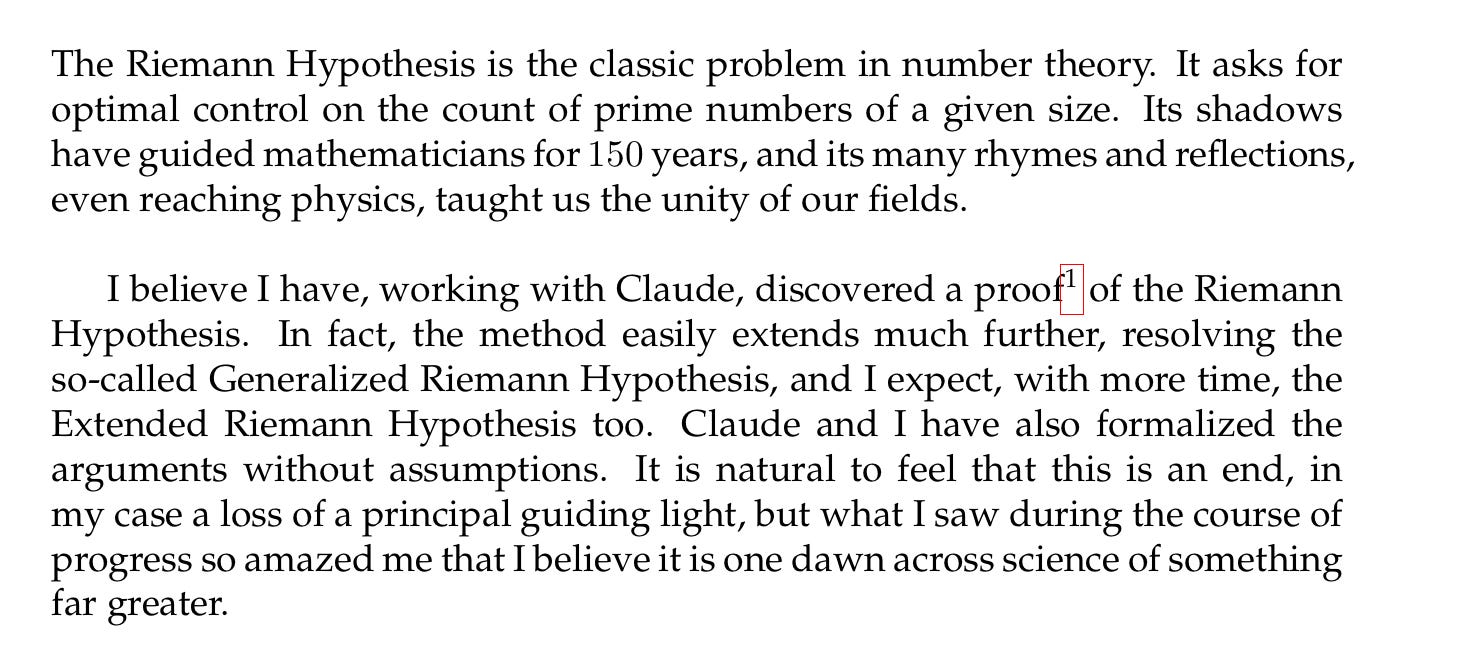
Levent Alpöge has solved the Riemann Hypothesis with help of Claude! What does it mean?
And why isn‘t it immediately rescuing the market?
TL;DR
- Levent Alpöge, a mathematician, appears to have proven the Riemann Hypothesis with assistance from Anthropic's Claude AI.
- The solution required extensive human guidance and expertise from Alpöge, not just AI.
- The achievement relied on specialized resources like the Lean AI system and the extensive math library, mathlib.
- The applicability of this method to non-mathematical domains is uncertain.
- The event is compared to DeepBlue's victory over Garry Kasparov, highlighting its specialized nature.
- The market response has been muted, indicating a lack of immediate perceived impact on AI's commercial value.
The stunning news Friday, just after the market closed, was that Levent Alpögeappears to have proven the Riemann Hypothesis with the help of Anthropic’s Claude.
This is truly, genuinely amazing.
But it has also (as is often the case) been widely misinterpreted.
To begin with, on social media, many people seem to think that AI *alone* solved the Riemann Hypothesis. This is not the case.
Indeed, as far as I can tell, current AI couldnothave done it on its own.
Critically, the solution required extensivehumanguidance from Alpöge, an exceptionally talented mathematician with expertise in AI. He workedtogetherwith the AI to jointly solve RH, over a period of months.
As AI math pioneer Christian Szegedy put it, “Levent made all the right (life) choices at the right time” in order to achieve the result, and we wouldn’t be here otherwise. He didn’t just type in a prompt “Solve Riemann”, and get the final answer. His contributions in shaping the end product were considerable.
Fundamentally, then, a brilliant mathematician with brilliant instincts drove a deeply collaborative process.
Importantly, the results do not mean that AGI has arrived, or anything like that. (If it had, you wouldn’t have needed the human mathematician to guide the whole process.)
It doesn’t even mean the result is that useful or technically innovative; it is 250,000 pages (hardly elegant), and no general lessons about how to do math have yet been drawn, nor (so far as I have heard) have any new techniques or concepts yet been introduced.
Most importantly (from the perspective of gauging future impact), Alpöge and the Claude AI system relied heavily on a unique set of resources that you won’t find in a field like medicine. The solution depended heavily on not only on Alpöge’s considerable talents but also on a special-purpose symbolic AI solving system,Lean, and a vast math-specific library,mathlib, built to work with it. The latter, mathlib, consists of “over two million lines of formalized mathematics” built over multiple yearsby hundreds if not thousands of people.
That library is fantastic for math, but also specialized for math. It is presumably of relatively little value for solving more open-ended problems in domains like biology, business, or robotics.
And critically Lean and mathlib revolve around formal verifiability, which is straightforward in math but difficult to achieve elsewhere. Exactly asI predicted in 2024, verifiable methods have helped more with math than with other domains.
In short, it’s not at all obvious that whatever Alpöge did has the generality many people are hoping for.
As Jeremy Kahn put it “Solving RH doesn’t help you negotiate a contract better or correctly figure out a corporate tax return. So no real change to enterprise value prop.” Or in Google DeepMind’s Sebastien Krier’s words, “Solving an old pure math problem does not immediately widen Anthropic’s operating margins”.
§
It’s feels to me kind of like that moment when DeepBlue beat Garry Kasparov in chess in 1997: an absolutely amazing use of brute force in a special-purpose way that didn’t generalize to all that much else. A lot of people wrote about how it would change the world; it didn’t.
The market seems to get all of this–RH hasn’t moved Anthropic stock much after hours—even if a lot of AI fans don’t.
Clinging to the Riemann results like a life raft after the stock market correction– as AI hypesters on social media are doing—doesn’t change the fact that (a) current AI still isn’t trustworthy enough to for many applications and (b) is still not profitable enough to warrant the massive investments.