China has all but caught up. The US is not going to “win” the AI war. Here’s what we should do instead.
Seven options, considered
TL;DR
- Chinese AI models like Kimi K3 are now comparable to top U.S. models and are available as free, open-weight downloads.
- The business models of U.S. AI companies like OpenAI and Anthropic are under serious threat, potentially jeopardizing their IPOs.
- The U.S. government's previous AI strategy, particularly its focus on LLMs and lack of consideration for open-source advancements, may have backfired.
- Potential future strategies for the U.S. include doing nothing and letting companies fend for themselves, outlawing open source, creating regulatory moats, bailing out major AI labs, banning Chinese models, buying out U.S. AI labs to create national laboratories, or pursuing AI as a global public good akin to CERN.
- A 'CERN for AI' model, promoting international collaboration and making AI a public good, is presented as a promising long-term solution, potentially boosted by receptiveness from China.
- The author critiques past U.S. government decisions, influenced by Silicon Valley, for leading to a precarious economic situation and potentially squandered leadership in AI.
- An investigation into how the U.S. lost its AI lead is recommended, exploring strategic errors, IP protection, Chinese government subsidies, espionage, and immigration policies.
Three weeks ago,I warned here that
“The ultimate culmination of the “no moat => more competitors => price wars => profits are scarce” argument that I have been making here regularly since the summer of 2023,has arrived— and may wreck the U.S. AI industry”
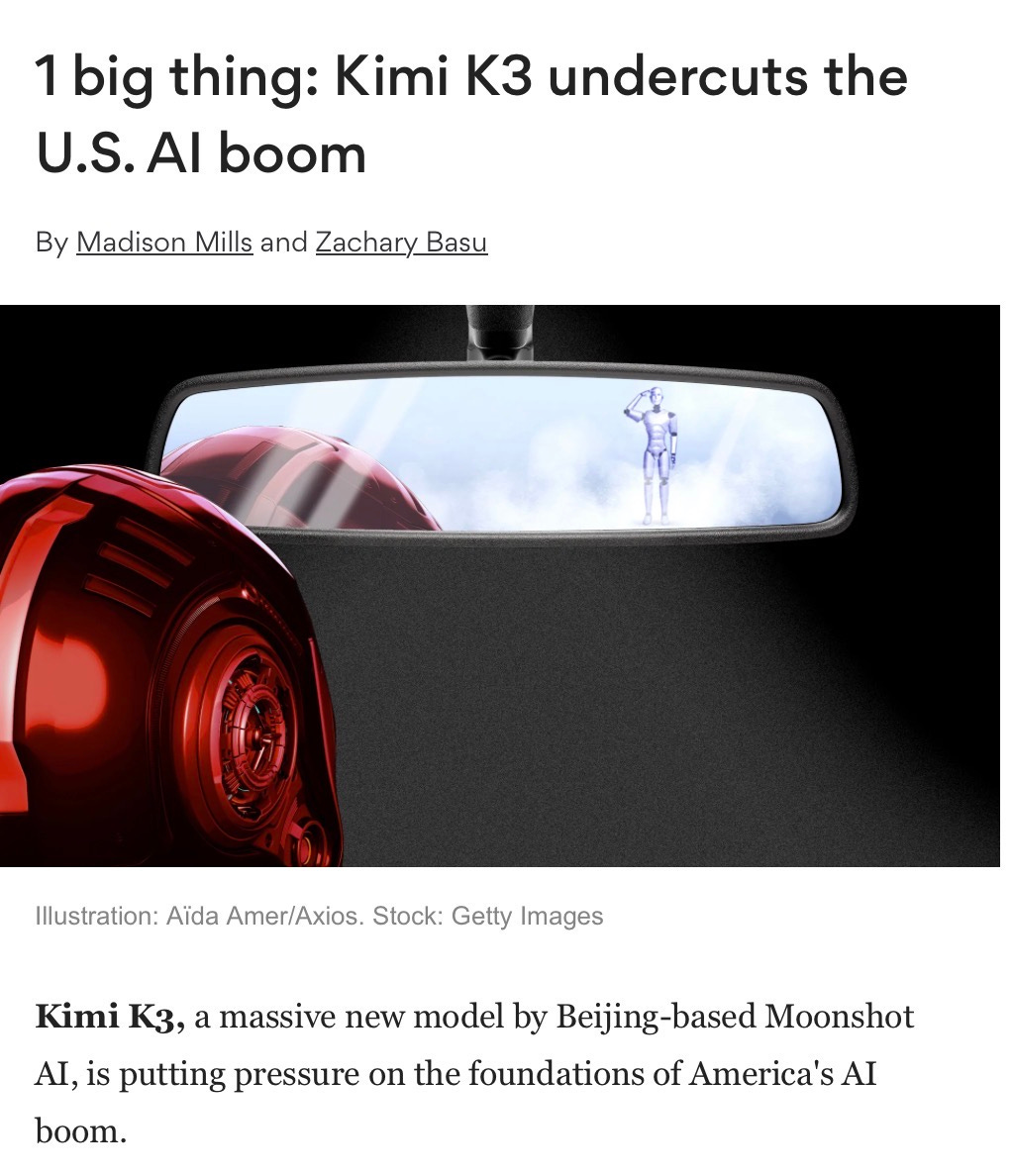
Last week, the Chinese company Moonshot.AI announced a model called Kimi K3 that is largely on a par with the best American models, and unlike those models, it is an “open weight” model that consumers will be able to download to run locally (if they have the large-scale hardware to support it) for free. The US stock market dropped partly on this news Friday, and the repercussion are likely to be immense. It’s no fluke, either. Chinese model GLM 5.2 from Z.ai made shockwaves not long before. Alibaba’s new Qwen model may add to the disruption.
All this calls the business models of OpenAI and Anthropic into serious question, and may kill or greatly undermine their IPOs. It also casts serious doubt on the never-too-plausible idea that America might “win” the AI race.
Ryan Fedasuak (who later went on CNN to discuss) expressed some surprise at this:
@AEI:\n\naei.org/foreign-and-de…","username":"RyanFedasiuk","name":"Ryan Fedasiuk","profile_image_url":"https://pbs.substack.com/profile_images/2027839612840734720/V1K7-Qn-_normal.jpg","date":"2026-07-17T15:08:29.000Z","photos":[],"quoted_tweet":{},"reply_count":28,"retweet_count":43,"like_count":168,"impression_count":49900,"expanded_url":null,"video_url":null,"video_preview_media_key":null,"belowTheFold":false}" data-component-name="Twitter2ToDOM">But it’s not like anyoneshouldbe surprised. The essay I wrote in January 2025 after DeepSeek came out — which one reader last week called “scarily accurate” —pretty much laid it all out.At the time I warned that
the US would not achieve a decisive victory in AI over China if they continued to focus largely on LLMs
that we would instead converge on a tie
that the lack of a technical moat would mean that companies like OpenAI would remain unprofitable.
that Nvidia would be vulnerable
that the CHIPS act would backfire, without doing much to hold China back
that models will continue to get more efficient and less expensive, but that hallucinations and reliability problems will persist.
that racing endlessly around LLMs would sap resources that could instead go into developing more original ideas.
That’s basically what has happened. I wish more people had listened.
That they didn’t is probably inevitable in government that lacked distance from Silicon Valley, and rarely consulted anyone for an outside opinion. By treating Silicon Valley fantasies as real, US government has massively blundered; the economy is now precarious, the companies they supported seem marginal, and China seems poised to undercut those companies further. We should never have gone all-in on GenAI, which never seemed to offer much in the way of a technical moat, in the first place.
A bunch of cheap xenophobic dismissals of China got us nowhere.
The question is what should we do now?
§
Well, to begin with, Congress ought to investigate. How did the US squander its lead? Were there strategical or tactical errors made? Was going all in on a single technology that could be replicated foolish? Did US companies do enough to protect their IP? Is the Chinese government subsidizing the Chinese companies, and to what degree? Is espionage from China involved? Are the US companies making good choices? Would investments in US companies likely make money or lose money? Have restrictions on immigration backfired, leading to a talent drain? (Kimi’s founder went to Carnegie Mellon and returned to China. Why?) Are there lessons to be learned for the next iteration of AI, or future technologies such as quantum computation or fusion?
But investigation won’t take us far. The real questions are strategic.
§
Here are seven options the Trump administration might consider, ending with a wild card that long-term might do more for the world than any of the first seven.
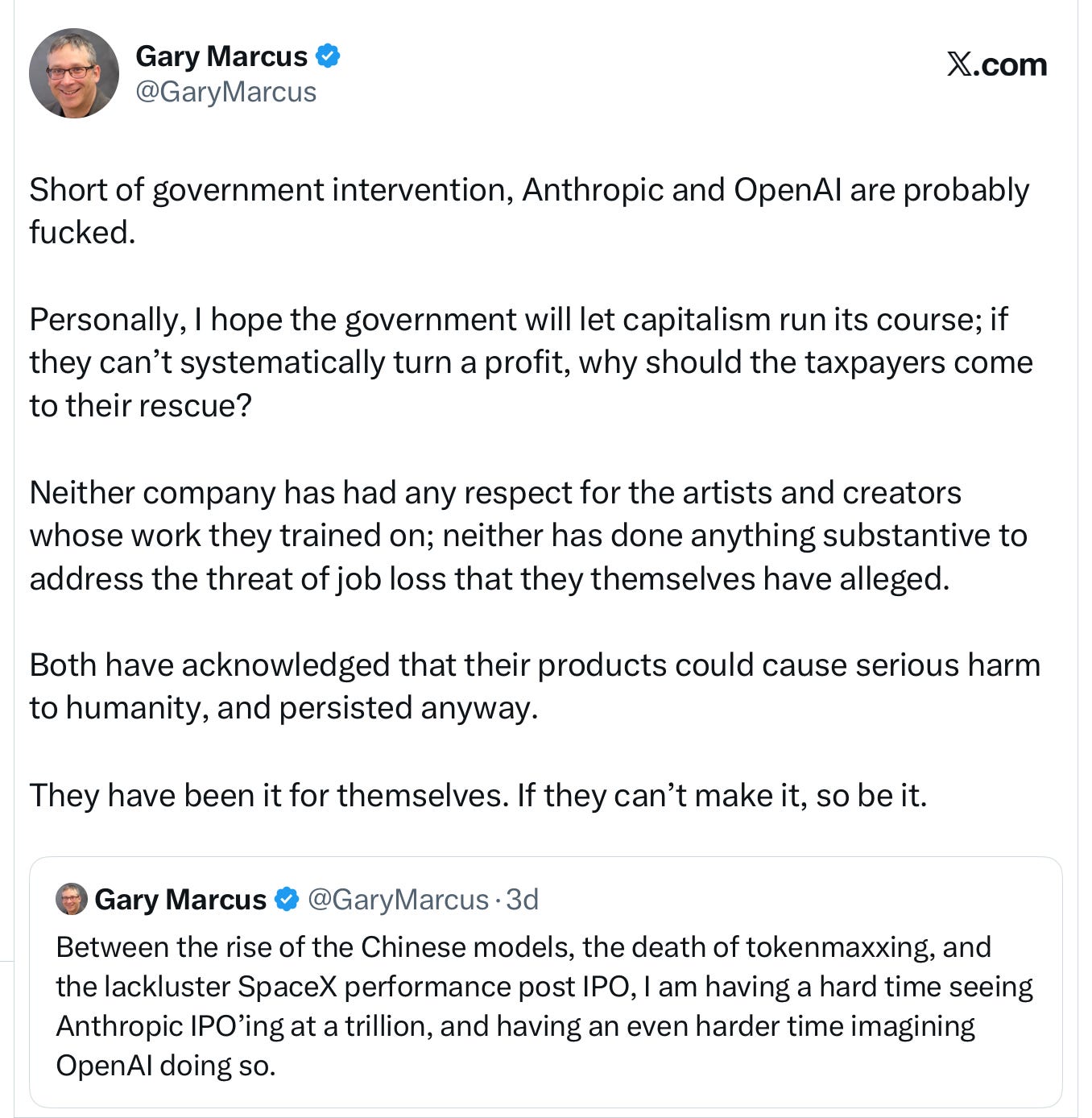
Do nothing. Let OpenAI and Anthropic stand on their own feet. No government subsidies or backdoor bailouts. If OpenAI and Anthropic can find a way to thrive, e.g., by focusing on narrow verticals, or “forward deployment” focusing on individual large customers, great. If they go under, so be it. Google and Microsoft and Amazon aren’t going anywhere, and can provide for US needs, especially classified ones where Chinese models presumably won’t be welcome. This may however concede a lot of the AI market to China, so it’s not ideal.
Outlaw open source. Good luck with that; at least with LLMs, the cat is already out of the bag. (And even if it were illegal, at this point it would continue to thrive on the dark web, and in countries that didn’t ban it.
Build a regulatory moat,as a backdoor way of protecting American companies. Over the weekend Dean Ball, who just moved to OpenAI seemed to argue that this is where things are headed.1I hope not. AsWill Manidis puts it, this would be protectionism, “… a proposal to use the informal, coercive power of the terminal, late-stage bureaucratic state to clear the American market of a cheaper frontier competitor to OpenAI or Anthropic.” This would also likely crush US startups. In Matt Stoller’s words, it is “corporate communism” in lieu of an open and competitive market. Certainly it would slow down progress and raise prices, helping two US companies at the expense of hundreds of thousands of others.
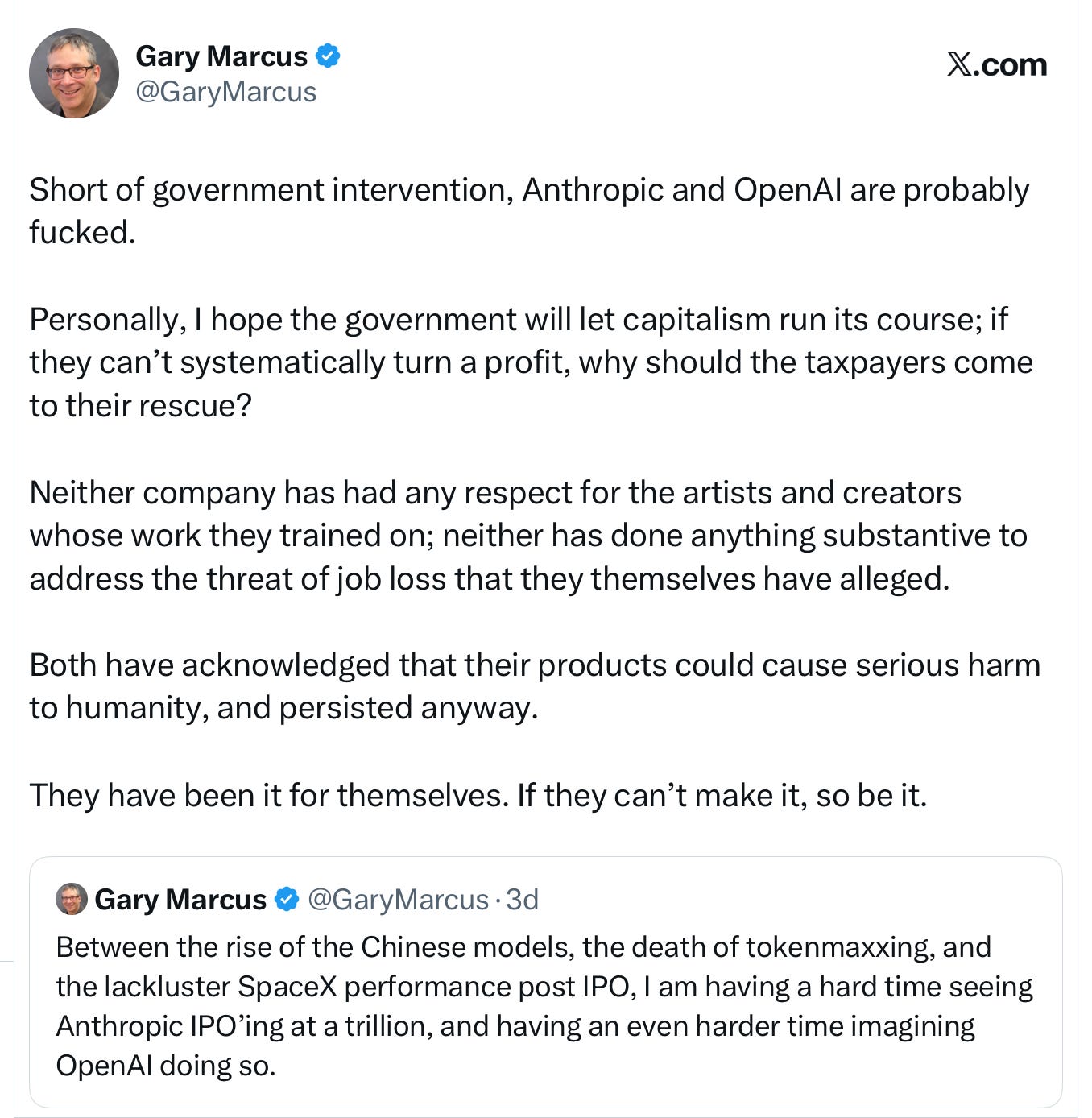
Bail out the big AI labs. Just no:
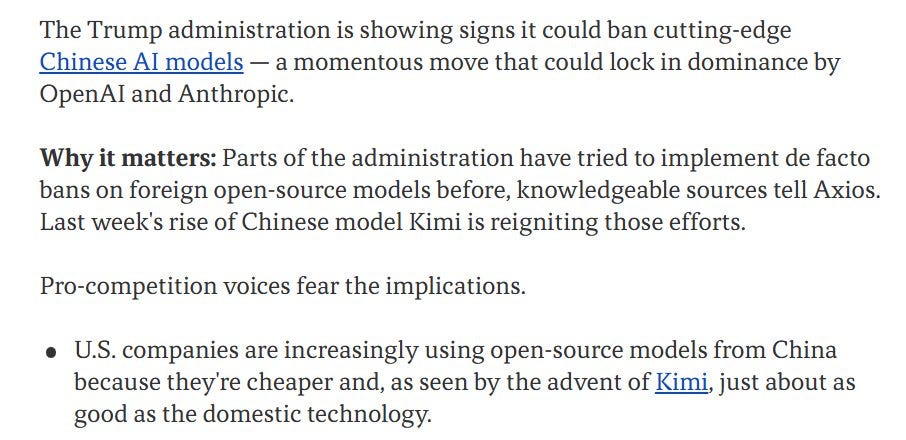
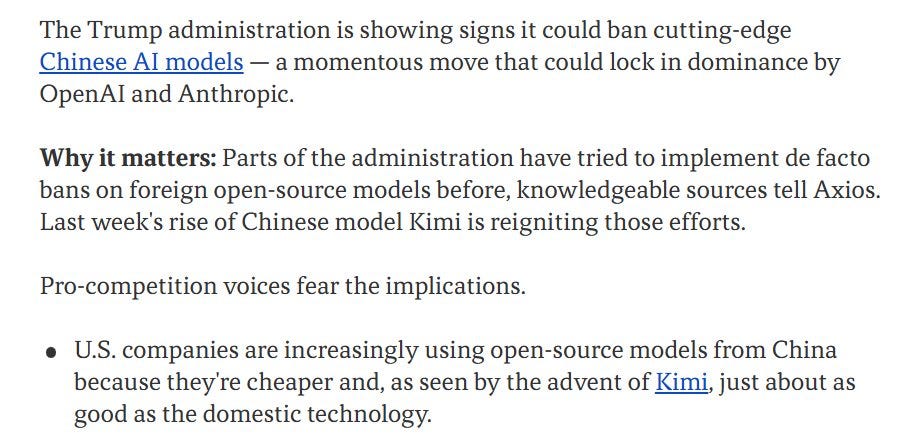
Ban Chinese models altogether.Axios thinks that might be in the works. Variant on the above; sure to raise prices to consumers, and stifle innovation.
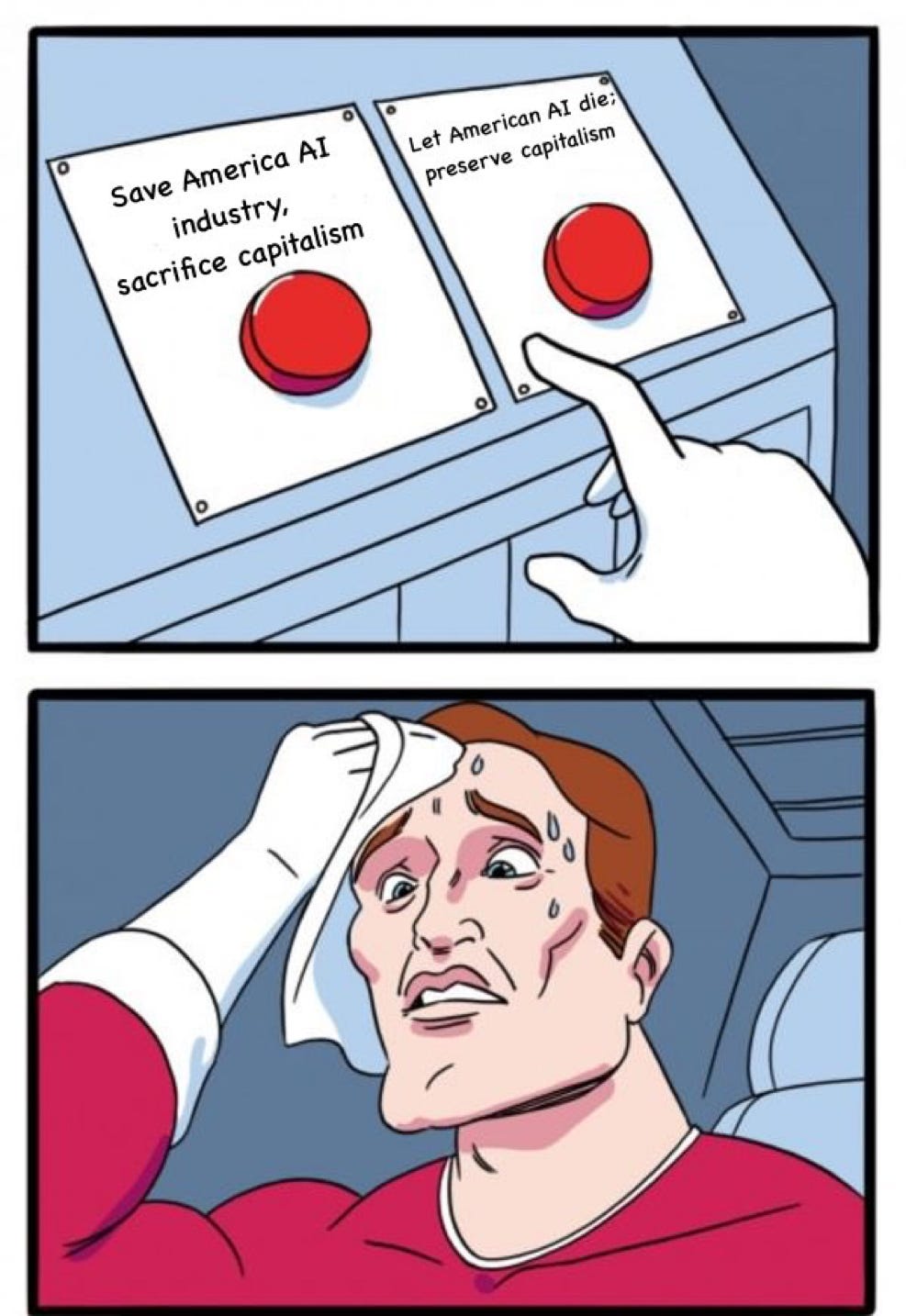
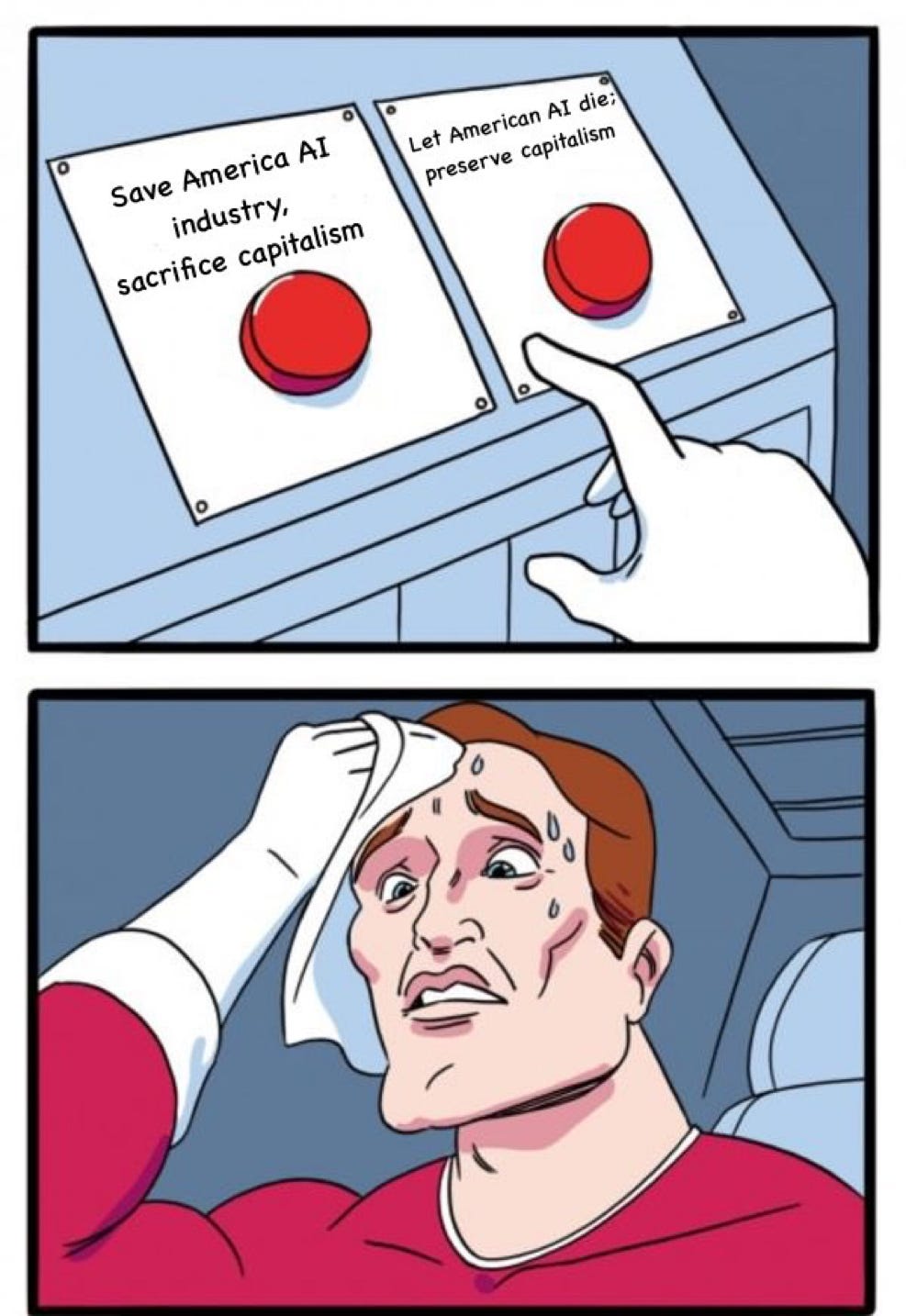
Even before I read the above rumors, I made a joke about this on X:
As investor and CEO Phil Libin put it to me in a message this morning, “The American system benefits when there’s free flow of capital, ideas, and people. We don’t need to “win” a zero-sum game. We win by transforming games to non-zero-sum. This is how we won the 20th century and it’s our best shot of winning the 21st.”
Buy out the big AI labs, OpenAI and Anthropic, altogether, for two cents on the dollar — which is generous, since they are both mostly money-losing ventures in an industry that has yet to convincingly establish profitability. Turn them into national laboratories, available to all accredited scientists through a competitive process. Since AI is bult on human IP that has largely been taken without compensation, there is poetic justice here, too. The downside is what unsavory things the government might do with the data, e..g, in terms of mass surveillance. Given that Hegseth blasted Anthropic for refusing to do just this, and given the current administration’s tendency to prosecute critics and enemies on thin grounds, we should worry about government abuse.
Give up on the zero-sum effort to “win” the AI war, and instead move towards making AI a global public good. In 2017 in the New York Times (based on a talk in 2016 at the conference AI for Good) I proposed a “CERN for AI”, writing
I look with envy at my peers in high-energy physics, and in particular at CERN, the European Organization for Nuclear Research, a huge, international collaboration, with thousands of scientists and billions of dollars of funding. They pursue ambitious, tightly defined projects (like using the Large Hadron Collider to discover the Higgs boson) and share their results with the world, rather than restricting them to a single country or corporation… An international A.I. mission .. could genuinely change the world for the better — the more so if it made A.I. a public good, rather than the property of a privileged few.
Maybe now is finally the moment? For a long time the odds of pulling this off seemed long, but maybe the time is right. China itself seems warm to something of the sort, per a speech that Xi Jinping just made, headlining an AI conference for the first time:
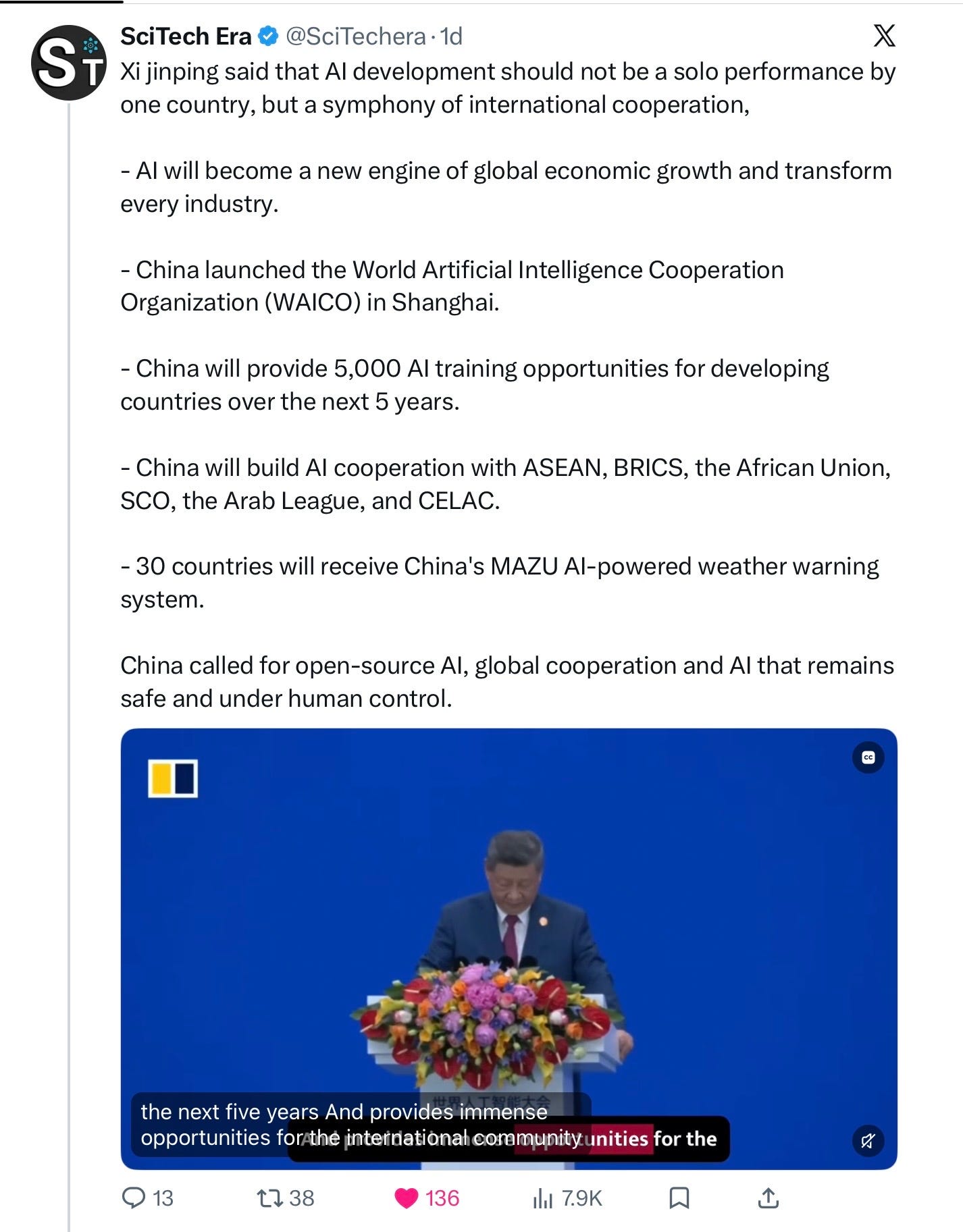
I don’t know whether to take Xi at face value — you can view his full talkhere) – but the fact that he said this gives a tremendous opening for discussion. I still think putting AI in the public domain, with an international effort towards medicine and science, would be a good idea. Of the options I have discussed, it seems to me to be the most promising, a last-ditch way to turn AI, built on so much of the internet that was sourced from hard work and thinking of the public, largely without compensation, into a true public good for the world.
If Trump actually wants to earn a Nobel Peace Prize, this could be his chance. A decision to outlawclosedsource AI — requiring all manufacturers to share their weights, architectures and training data with accredited scientists and research organizations — combined with a deal with China to dedicate AI to the public good – would be a great gift to humanity.
Gary Marcusproposed a CERN for AI in 2016, echoing it gently at the Senate in 2023, and would be thrilled to see some variation on that idea see the light of day.
1In a later tweet, Dean claimed he was not proposing that the US adopt a regulatory moat to keep China out it, just stating it as inevitable. (Few people on X believe him; most seem him as retrenching in the face of huge opposition. I leave his intent open.)