The Sequence Radar #893: Last Week in AI: GPT-5.6, Grok 4.5, Muse Spark 1.1 and the Post-Chatbot Stack
Next Week in The Sequence:
TL;DR
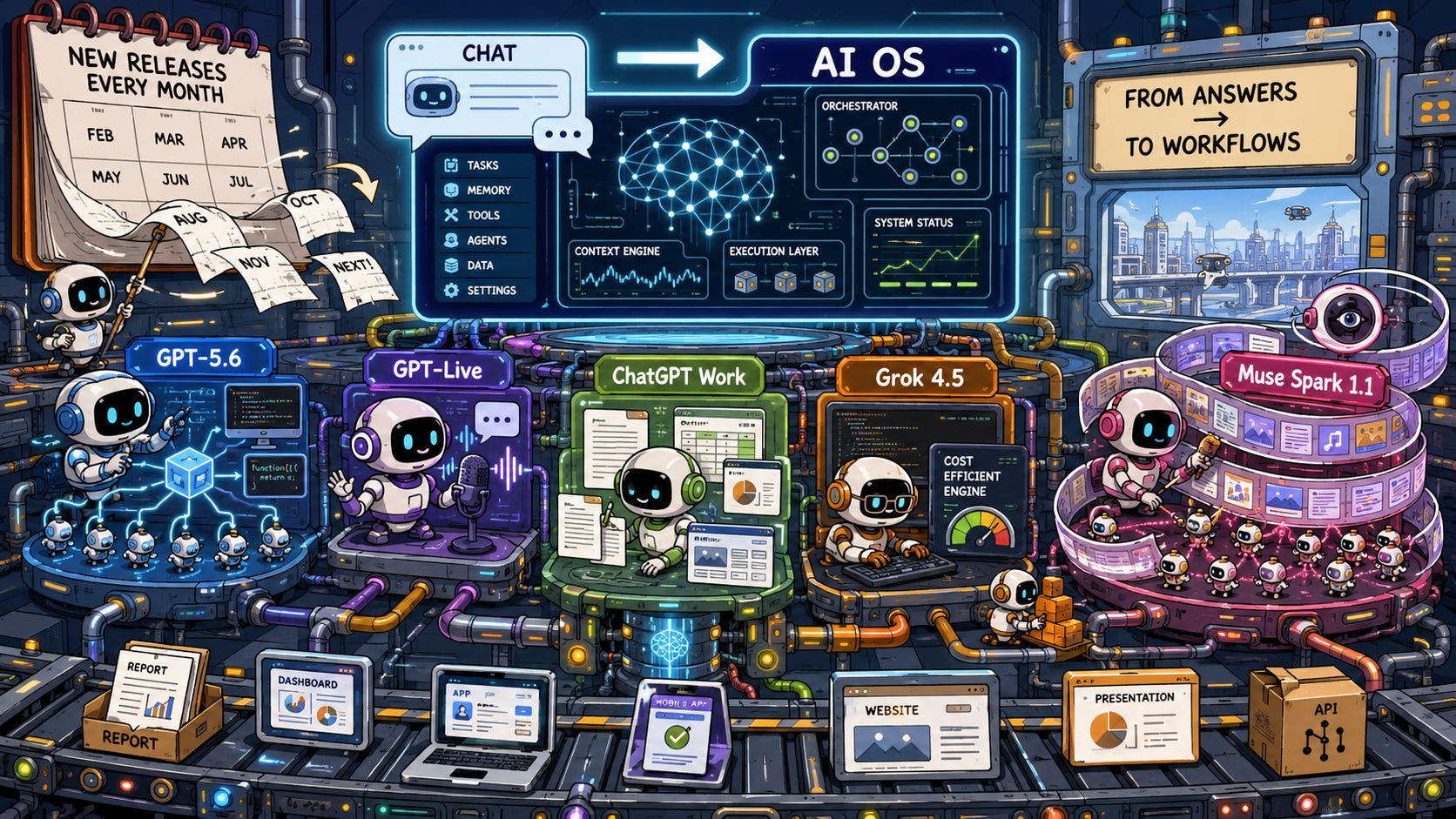
- AI labs are releasing new models and interfaces monthly, moving from chatbots to AI as a runtime.
- OpenAI's GPT-5.6, GPT-Live, and ChatGPT Work enhance AI capabilities with programmatic tool calling, full-duplex communication, and artifact production.
- Meta's Muse Spark 1.1 and Grok 4.5 introduce large context windows, multimodal perception, and competitive pricing for AI services.
- The AI race focuses on vertical integration of models, voice, agents, and interfaces to own the loop between intent and outcome.
- New failure modes arise with long-running agents, requiring robust governance and rollback mechanisms.
- The frontier is shifting towards systems design, orchestration, and efficiency, not just static benchmarks.
- OpenAI's analysis revealed issues in the SWE-Bench Pro coding benchmark, highlighting the need for better evaluation methods.
- Anthropic's GRAM method allows compartmentalizing and toggling dual-use knowledge in AI models.
- SkillOpt-Lite offers a faster, simpler approach to autonomous agent skill optimization.
- DSpark improves speculative decoding by scheduling verification lengths based on system load.
- NVIDIA's Nemotron-Labs-Diffusion unifies autoregressive, diffusion, and self-speculation decoding in one model.
- Google Research, UC Berkeley, and Stanford GSBS conducted experiments showing urban congestion relief through routing-app interventions.