No, Dario Amodei, we will not be curing cancer and “most human disease” in five to ten years
What Amodei left out
TL;DR
- Dario Amodei claimed AI could cure most human diseases in 5-10 years, including cancer.
- Experts like Eric Topol, Lior Pachter, and Keith Robison dispute Amodei's timeline, citing the complexities of medical science.
- A previous essay noted that over a decade of AI efforts had not resulted in a single AI-designed drug reaching clinical adoption.
- Challenges include economic and technical hurdles, as well as the necessity of time-consuming clinical trials.
- Critics suggest Amodei's optimism is unrealistic and potentially gives false hope.
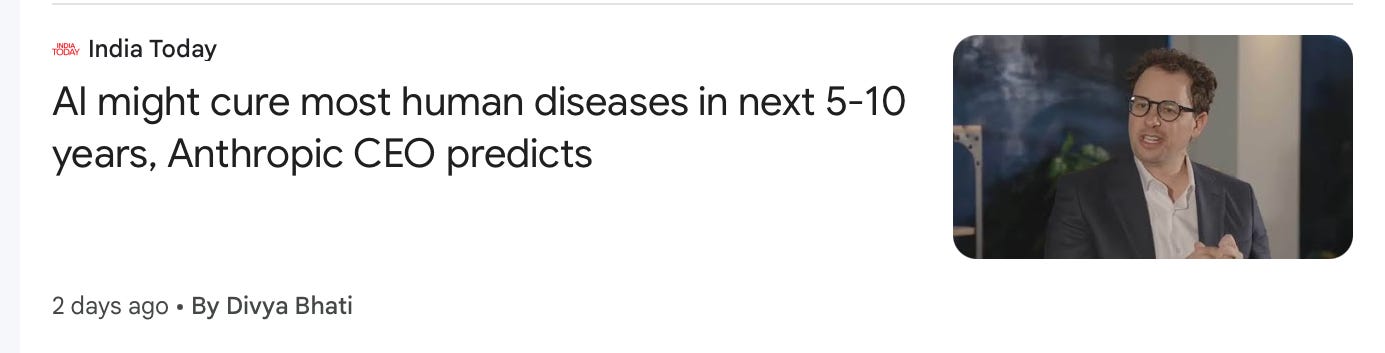
On Saturday, Dario Amodei claimed (in a long defense of his company’s approach to AI) that he thinks it “will actually be possible to cure most human disease in ~5-10 years”, highlighting “curing cancer” among other goals. As usual, some in the media ate it up.
And I wish it were true. But his timeline is so naive as to be absurd, both with respect to how medical science works and why it is challenging.
Marcus on AI is a reader-supported publication. To receive new posts and support my work, consider becoming a free or paid subscriber.
If you haven’t already done so, Istronglyrecommend you read (or reread) the March essayI wrote about AI and cancer, which builds on an essay by Emilia Javorsky. That essay started with Javorsky’s observation that (as of March) not one drug designed by AI had yet reached clinical adoption, even after over a decade of efforts.
Part of the crux of my essay (and hers) was that even if AI were a lot better, curing disease is hard, both economically and technically, and you also can’t simply skip the time-consuming clinical work. (I further argued that we don’t really have the right kind of causally- and biologically-sophisticated AI yet. New advances in AI and math don’t fundamentally change what I wrote there.)
The happy news is that you don’t have to take my word for any of this anymore. The mood has changed, and this time a whole pile of people pushed back. I have yet to see Amodei’s ridiculous claim dissected in the mainstream media, but below are some of the many tweets over the weekend that rightly took Amodei to task.
Please consider becoming a subscriber.
Let’s start with Eric Topol, a well-respected and very pro-AI physician/researcher who is having none of it. (Topol also notes that Hassabis made a similar absurd argument last year on60 Minutes, maybe the most naive things I have ever heard Hassabis say. AI mightsomedaycontribute as Hassabis says, but certainly not in the next decade. Many of the quotes below happened to be directed to Amodei, who was in the news, but apply to what Hassabis claimed as well.)
By way of setting realistic expectations, Topol adds:
Caltech’s Bren Professor of Computational Learning, Lior Pachter, wrote
Computational biologist Keith Robison:
Cancer biologist John Herrman wrote (plausibly if optimistically, but nowhere near as optimistically as Amodei):
@EricTopol@GaryMarcusMuch more defensible:\n\nAI could plausibly accelerate a few medical breakthroughs over next 10 years that surpass today’s best advances. \n\nThat’s far different from “AI will cure most human disease” including complex dynamically evolving disease states like many malignancies etc","username":"ablT315I","name":"John Herrmann, PhD","profile_image_url":"https://pbs.substack.com/profile_images/1248003271945404417/GHCne23C_normal.jpg","date":"2026-08-17T02:48:38.000Z","photos":[],"quoted_tweet":{},"reply_count":0,"retweet_count":0,"like_count":2,"impression_count":31,"expanded_url":null,"video_url":null,"video_preview_media_key":null,"belowTheFold":true}" data-component-name="Twitter2ToDOM">MD/PhDMarios Georgakisasks:
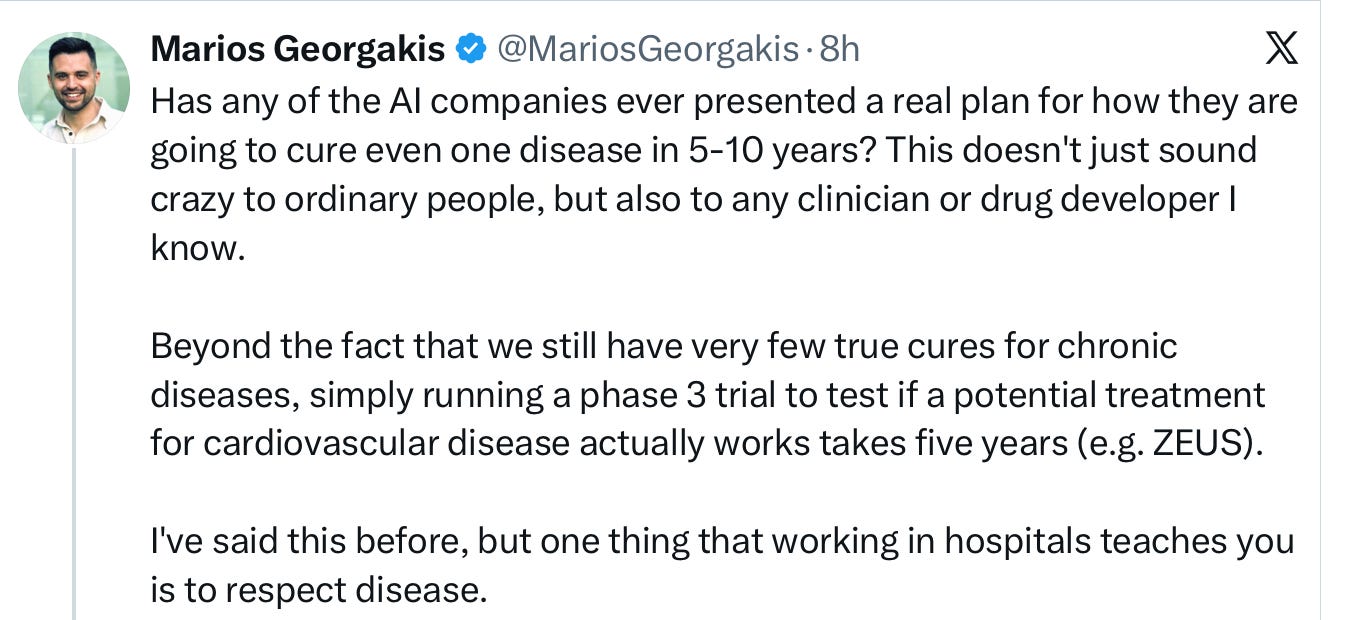
(As far as I know, the correct answer to the question about real plans posed in the first sentence is a simple “no”.)
The software engineer/enterpreneur Chombe Bupe, responding to Georgakis, adds:
Even the ultimate AI optimist, Wharton professor Ethan Mollick, wasn’t really buying:
Penultimate words to Dr. Catharine Young, a Senior Fellow at the Harvard Chan School of Public Health, in a brutal pair of tweets further underscoring Amodei’s naïveté with respect to medicine.
and
§
There are a great many things about Amodei that I respect, including both his technical chops and business sense, as well as his bravery in standing up to the US government on important matters. But his habit of giving people unrealistic hope is not one of them. (See also the time he claimed that AI coulddouble human lifespan by the end of the decade.)
In fairness, Amodei may believe what he says, but in that case he ought take Dr. Young’s suggestion of doing a medical internship, in order to better calibrate his understanding of the challenges in medicine.